What is Generative Knowledge?
One Definition and Six Principles

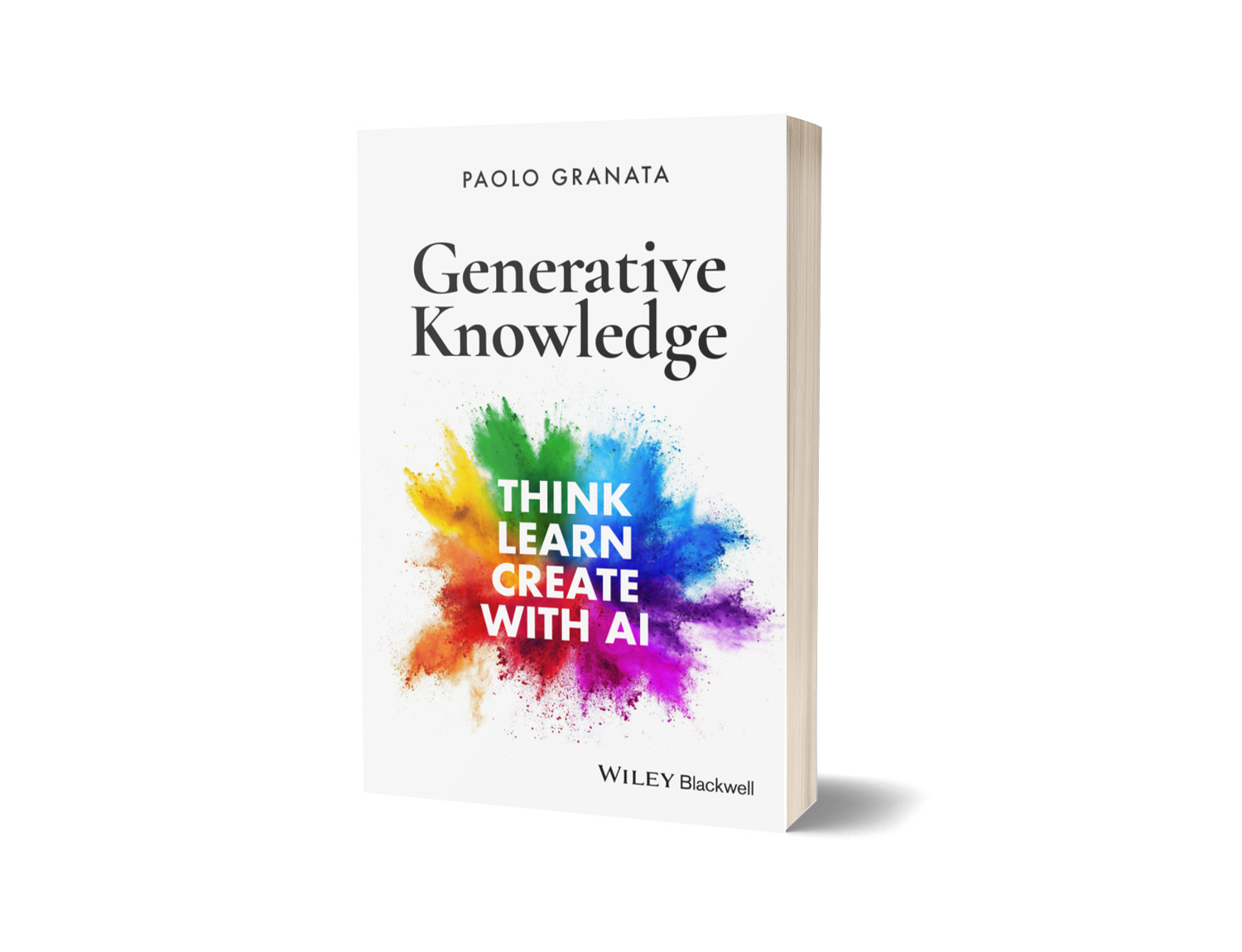
My new book, Generative Knowledge, is finally out, and now people ask me to explain what I mean by “generative knowledge.” The question delights me because it gets to the heart of something I’ve been thinking about for a long while. So, let me begin with the essential definition that anchors my entire book:
Generative knowledge is that distinctive form of knowledge that creates new knowledge.
At first glance, this might seem almost circular, even disappointingly simple. Yet, this definition rests on a profound claim. It asserts that knowledge is not merely something we possess, transmit, or store. It is something we generate. As I write in the book, “generative knowledge functions as a dynamic, self-expanding configuration of ideas and practices that reliably produces further, novel knowledge.” In this view, knowledge becomes less a fixed object than a living system, marked by its capacity to expand, transform, and initiate further inquiry.
In the book, I address what we might call the recursive nature of generative knowledge, and therefore address some core questions:
What distinguishes generative knowledge from other forms of knowledge?
Is it the inherent quality of the knowledge itself, or does it depend on other factors?
How is this distinctive form of knowledge prompted?
What are the processes involved in knowledge creation?
What conditions are necessary for generating new knowledge?
In formulating a framework for generative knowledge, I found it necessary to identify recurring patterns and structural features that appear across historical periods, cultural contexts, and epistemic practices. These patterns help us recognize when knowledge is behaving generatively; that is, when it produces more than it preserves, when it becomes a catalyst for new insight. What emerged from this reflection is a set of six principles, serving both analytical and operational purposes, offering a conceptual map for understanding how knowledge is generated as well as a guide for fostering its generative potential.
Six Principles of Generative Knowledge
I’ve identified six core principles that characterize generative knowledge. In a nutshell, generative knowledge stands on the solid groundwork of what has already been acquired, transmitted, and settled (iterative principle); it draws on equally tangible epistemic technologies (instrumental principle); it is social, flourishing through interaction with others and the vitality of collective intelligence (social principle). Genuine epistemic curiosity drives generative knowledge forward, serving as the engine of inquiry (inquiry principle); an ongoing impulse to keep learning—to learn how to learn, to unlearn, and to relearn—sustains its momentum (learnability principle); and ultimately, it springs from individuals or communities who consciously embrace intellectual creativity, a mindset that steers thought toward the production of new insight (creativity principle).
Together, these six principles form a conceptual framework. Each interacts with the others, and none operates in isolation. Taken as a whole, they offer a lens for recognizing when knowledge becomes generative, and a guide for cultivating the conditions that allow it to flourish. Each principle reflects not just how knowledge is generated, but also how it can be cultivated; a feature of any system that fosters recursive transformation: knowledge that begets new knowledge.
And AI?
In the book, I consider tangible strategies to employ the framework of generative knowledge and its six principles in a pragmatic way to explore the generative potential of artificial intelligence, to inquire how our relationship with knowledge is changing, and above all, to grasp the practical implications of thinking, learning, and creating with AI.
I confront questions like:
How might persistent engagement with AI systems, generative or otherwise, reorganize our epistemic virtues and intellectual habits?
What changes in metacognitive strategies do learners adopt when incorporating AI into their learning processes?
In what ways might co-creation with AI systems reshape conventional creative processes across different domains?
The book, organized into three distinct yet interconnected parts, explores each of these domains in depth—how AI and its generativity are reorienting the way we think, reconstituting the way we learn, and stretching the limits of what it means to create.
I hope you like it!
Post Scriptum: For readers who were previously disappointed by a definition of generative knowledge that was too sparse or synthetic, here is a more elaborate one that takes into account the six principles described above:
Generative knowledge is a distinctive form of knowledge defined by virtue of its inherent capacity to catalyze and sustain the creation of new knowledge through iterative, technologically mediated, and socially-embedded processes. Unlike conservational and retentive forms of knowledge that primarily serve preservation or consolidation purposes, generative knowledge functions as a dynamic, self-expanding configuration of ideas and practices that reliably produces further, novel knowledge; a system that, through human agency and technological amplification, exhibits self-propagating qualities that continuously expand the boundaries of human understanding, thereby fueling intellectual advancement across a range of domains and modes of inquiry, from scientific discovery, to technological innovation, to cultural development.
Paolo Granata, Generative Knowledge: Thin, Learn, Create with AI (Wiley 2025), p. 39
Discover the complete framework in Generative Knowledge: Think, Learn, Create with AI (Wiley 2025), available globally on bookstores.
Amazon.com | Wiley US | Wiley Canada | Wiley UK | Wiley Australia
Join the Generative Thinkers Community on SubStack to explore how knowledge creates knowledge. Connect with readers committed to understanding the creative force that drives human discovery.