
Epistemic Vigilance
The Art of Weighing Things Up

The human species appears bound to a peculiar fate: the ceaseless quest for meaning.
This search, however, demands that we constantly shift how we undertake it. It forces us to keep a watchful eye, periodically re-examining the values, conceptual frameworks, and criteria we use to assign significance to the world around us.
In a knowledge ecosystem already heavily shaped by artificial intelligence, this vigilance becomes central. Remaining mentally active, aware, and critical is no longer merely a personal preference; it is a social necessity for navigating an information environment that is dense, fluid, and often opaque. When this attention fades, the risk rises: we begin to rely uncritically on immediate answers, making room for a cognitive laziness that atrophies our ability to generate new knowledge.
True critical inquiry, by contrast, requires the cultivation of what cognitive scientists call epistemic vigilance. This is a mental habit wired for checking and verifying, a mindset that keeps a live pulse on coherence, evidence, and the reliability of sources.
In simple terms, epistemic vigilance is the mental habit of “weighing things up.” It is the cognitive safety valve that checks for coherence, evidence, and reliability. It is the ability to resist the brain’s natural urge to take the path of least resistance.
A Faustian Bargain
Every intellectual technology, once adopted at scale, alters the human cognitive environment, and this alteration always exacts a toll. It is a well-documented dynamic: increased efficiency always carries a cognitive cost.
We are facing a modern version of what media ecologist Neil Postman once called a “Faustian bargain.” Every time a new technology increases our efficiency, it demands a sacrifice in return. With AI, we gain incredible speed and efficiency. But what are we trading away? Well… epistemic vigilance.
When the machine validates our existing beliefs with authoritative-sounding prose, our critical defenses crumble. We stop checking the map. We confuse linguistic fluency with factual truth. This is why I argue that we need to reclaim the act of judgment.
The Auto-Pilot Problem
And yet, the relentless stream of cognitive stimuli characterizing our interactions with AI—conversations with LLMs, content from generative networks, algorithmic suggestions—seems to erode our capacity for epistemic vigilance. Why?
Because of the so-called automation bias. This is the tendency to place excessive trust in results produced by automated systems, a sort of mental autopilot we engage to lighten our cognitive load. Research shows that users tend to treat automated recommendations as intrinsically reliable, often ignoring contrary signals from other sources. The perceived authority of technology—an “aura of objectivity”—reinforces the illusion that automated equals correct.
The risk is that the automation of form produces an automation of judgment. The more convincing the output looks, the more inclined we are to suspend critical analysis. This is once again where epistemic vigilance becomes essential.
Generative Critical Thinking
Disengaging the autopilot means reclaiming the act of interpretation, recovering the responsibility of judgment, and remembering that a tool’s efficiency is not synonymous with the quality of its answers.
Whenever we outsource a cognitively demanding task to AI, our threshold of attention tends to drop. Overconfidence in the system lowers our standards of evaluation, allowing weak inferences to pass unnoticed. Epistemic vigilance is the most effective antidote to this drift. It calls us back to the core of knowledge seeking: activation, control, and responsibility.
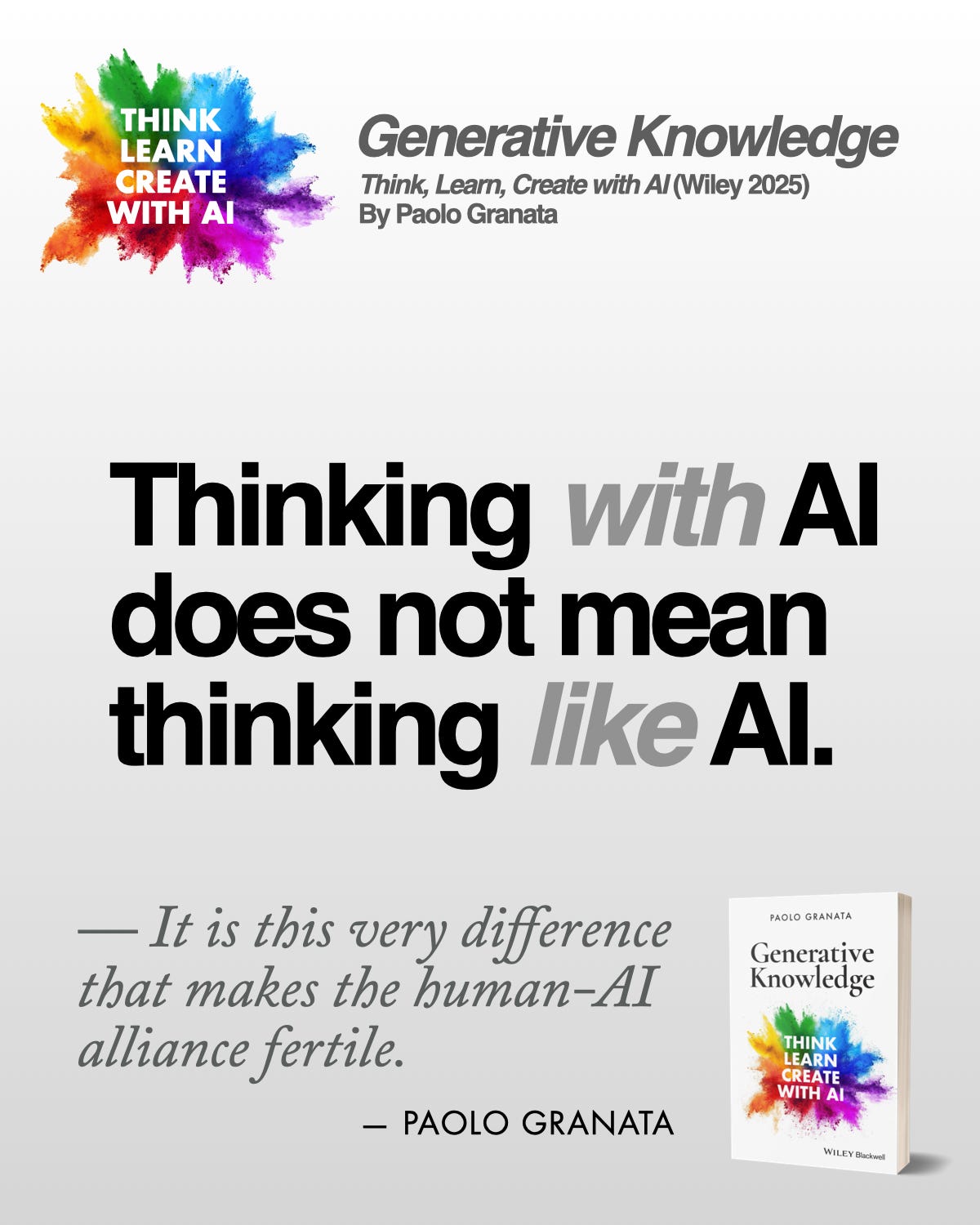
In my book, Generative Knowledge: Think, Learn, Create with AI (Wiley 2025), I explore epistemic vigilance as the fourth pillar of Generative Critical Thinking Framework. This fourth pillar—epistemic vigilance (the other ones are Epistemic Competence, Epistemic Authority, and Epistemic Trust—welds itself to the first, completing the cycle of Generative Critical Thinking. To cultivate this thinking—to think with AI productively—I believe we should understand the core of human-machine co-creation: recognizing that AI “thinks” differently than we do.
Thinking with AI doesn’t mean thinking like AI. Rather, it means transforming that distance into a resource. Even if machines were to one day achieve a form of thought akin to ours—a highly unlikely prospect—they would surely recognize this original difference. It is this very difference that makes the cognitive alliance fertile. It allows the AI to widen the scope of inquiry while the human maintains interpretative responsibility, turning the gap between the two processes into a cognitive advantage, for us.
Wow, the part about our knowledge ecosystem already being so heavily shaped by AI and how that makes epistemic vigilance a socail necessity really stood out, making me wonder how we can beter 'wire' this mental habit into our collective consciousness, and thank you for such an insightful piece!